
Key Takeaways
- Children with severe acute malnutrition at Doctors Without Borders MSF's Nilefa Kiji facility in Maiduguri, Borno State, may need treatment lasting from one week to a month, during which caregivers stay at the hospital.
- Caregivers, often mothers, face weeks of anxiety, uncertainty, separation from their families and fear of losing a child.
- MSF provides psychological first aid on arrival, followed by individual counselling, group sessions and structured play activities for children.
- Counsellors help distressed caregivers contact relatives by phone and, in some cases, arrange supervised home visits.
- A caregiver's emotional wellbeing influences their ability to stay engaged in treatment, follow medical advice and provide the care their child needs.
- In 2025, MSF teams treated 425,634 children for acute malnutrition across northern Nigeria, a 41.8% increase compared to 2024.
Severe acute malnutrition at MSF's Nilefa Kiji facility in Maiduguri
Children's cries fill the intensive care unit of MSF’s Nilefa Kiji nutrition facility in Maiduguri, Borno State, Nigeria. Nurses move from bed to bed, checking vital signs, dispensing therapeutic milk, and reassuring anxious parents. Every child here is fighting severe acute malnutrition, a condition that continues to claim young lives across northern Nigeria.

Symptoms, related diseases and length of treatment
Many have suffered severe wasting and weight loss. Since malnutrition weakens their immunity, some also arrive with other diseases too, such as measles, diphtheria, and malaria. For many children with severe acute malnutrition, treatment can last from one week to a month. Throughout that time, caregivers remain at the hospital, often separated from their families and burdened with worries of what waits for them at home.
The emotional toll on caregivers during malnutrition treatment
The stories of caregivers – often mothers of the children – rarely get told. Yet their emotional well-being is tested by weeks of anxiety from their child’s condition, uncertainty, separation from their families, and the fear of losing a child

Caregiver stories from Northern Nigeria
Fatima Ibrahim: worried about eight children left at home
Fatima Ibrahim’s 23-month-old daughter, Aisha, was admitted to the Nilefa Kiji nutrition facility in Maiduguri after battling meningitis and repeated convulsions. The three weeks spent in hospital were filled with conflicting emotions. While grateful to see her daughter improve, Fatima could not stop thinking about the eight children she had left at home.
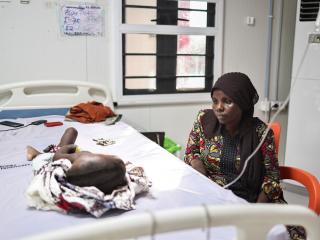
Fatima Ibrahim, on learning that a child at home had a fever and there was no money for treatment:
One day, she learned that one of them had developed a fever, but there was no money for treatment. “I cried and could not eat,” she said. “Even this morning, I could not eat until the afternoon.”

Halima Mohammed: 45 days moving between hospitals with two sick children
Another mother, Halima Mohammed, experienced a different kind of strain after spending 45 days moving between hospitals with two sick children.
Halima Mohammed, mother of two sick children, on her sleep, her health and her request for her daughter's discharge:
“I was having good sleep before my children fell ill,” she says. “Now I barely sleep. For the past two days, I have not been feeling well myself. I pleaded for my daughter’s discharge, and I assured them that I was not running away; that my daughter is now better, but they advised against self-discharge as my daughter was not yet in a stable condition.”

Latifat Abdulkareem: a son asks when She Is coming home
Latifat Abdulkareem, mother whose daughter was admitted, on a visit from her eldest son:
Latifat Abdulkareem faced another painful dilemma when her eldest son visited the hospital during her daughter's admission. “He asked me when I was coming home,” she said. “He said they were hungry since I wasn't around.”

Kethurah John: caregivers face two difficult choices
Helping several caregivers whose children have been admitted for malnutrition, Kethurah John, an MSF counsellor educator, says that the condition of their children at home leaves caregivers with two difficult choices, and that sometimes their husbands do not help the situation.
Kethurah John, MSF counsellor educator, recounts a mother of six who left the hospital.
Kethurah says, “She could not cope with staying in the hospital. She had six children. She had to leave, not because she wanted to, but because she feels this is just one child. And every day when she is given food, she cries because she is thinking of her children; maybe they can’t get that.”
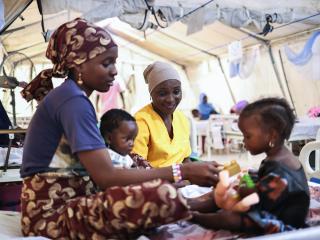
Mariya Mukhtar: finding reassurance at an MSF facility in Kano.
For Mariya Mukhtar, nine days after arriving at an MSF facility in Kano with her severely ill daughter, the hospital had become a place of reassurance. Her daughter had arrived with a severe fever, vomiting, and loose stool after several unsuccessful visits to other health facilities. Mariya feared she might not survive.
After some time, she began seeing a dramatic change. Her daughter could now sit up, play, recognise her and talk- things she could not do when they arrived.
Mariya Mukhtar, mother of a severely ill daughter, nine days after arriving at an MSF facility in Kano.
“I am in no rush to leave,” says Mariya, because she can see real improvement every day. She now feels at ease, knowing her daughter is receiving care.

The overlooked consequence of malnutrition
These stories reveal an often-overlooked consequence of malnutrition. While medical statistics capture admissions and recovery rates, they cannot measure the emotional burden people carry while trying to support their sick children.
How MSF supports caregivers' mental health in Nigeria
To address these challenges, MSF integrates mental health and psychosocial support into our malnutrition programmes in Nilefa Kiji nutrition facility. Caregivers receive psychological first aid on arrival, followed by individual counselling and group sessions where they can share experiences, express their fears, and learn coping strategies. Children also participate in structured play activities that help restore a sense of normalcy during recovery.


For us, those moments remind us that caring for the caregiver is also part of caring for the childKethurah John, MSF counsellor educator
Phone contact and supervised home visits for families
The support extends beyond counselling. When caregivers become distressed after losing contact with relatives, counsellors help them reach family members by phone. In some cases, supervised home visits are arranged so caregivers can briefly check on their families before returning to complete their child's treatment.
Caregivers regain hope as children recover
Kethurah says many caregivers gradually regain hope as they witness their children's recovery. Some even return after discharge simply to show how healthy their children have become.
Why supporting caregivers matters for child recovery
Supporting caregivers is more than an act of compassion. Their emotional well-being influences their ability to remain engaged in treatment, follow medical advice, and provide the care their children need to recover.
As the fight against malnutrition continues, the needs of children and those who care for them cannot be separated. Healing is not only about restoring a child's weight. It is also about restoring hope and resilience to the person who sits at the bedside every day.
MSF's malnutrition response across Northern Nigeria
MSF supports the state Ministries of Health in Zamfara, Katsina, Kebbi, Borno, Bauchi, Sokoto and Kano in providing lifesaving care for children suffering from malnutrition. In 2025, MSF teams treated 425,634 children for acute malnutrition across northern Nigeria, a 41.8% increase compared to 2024.

The fear that follows migrants returning to Zimbabwe from South Africa

Somalia survey finds every second child in Baidoa displacement sites acutely malnourished
