MSF Social media guidelines

How To Use Your Personal Social Media Accounts Responsibly

When used responsibly, social media can help us share our work.

Use the three core materials listed below to guide your own personal social media use to avoid harming to yourself, your peers or the communities we serve. 

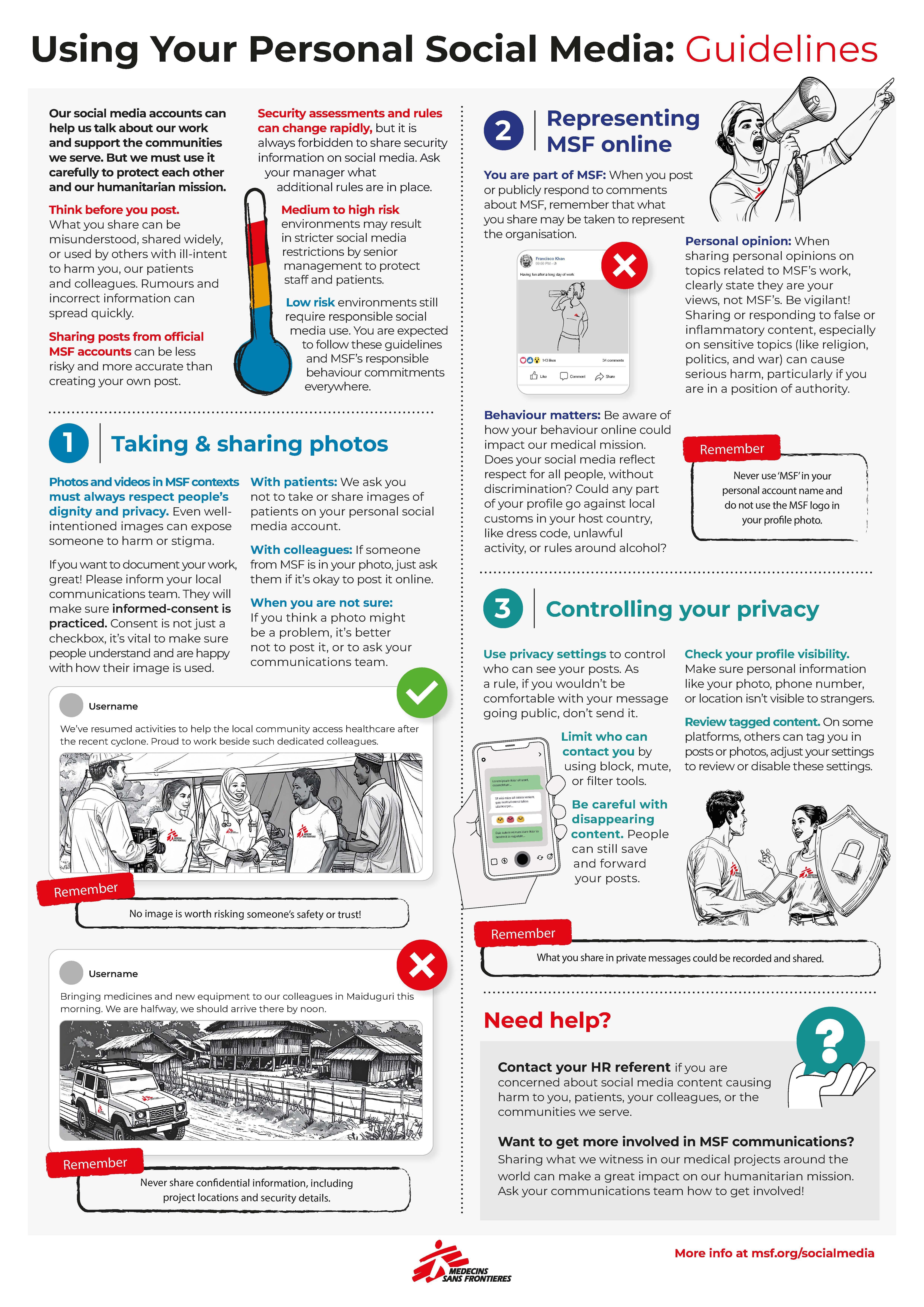
  1. MSF's Social Media Guidelines poster (see below) outlines the main points of responsible social media use when using your personal accounts.
     
  2. MSF Behavioural Commitments detail the minimum behavioural standards (offline and online) expected of all staff. 
     
  3. Staff handbooks/ office employee policies may also apply in your office that go beyond these guidelines. Ask your manager what rules are in place.


MSF Social media guidelines
Social Media Guidelines 2025 pdf — 2.65 MB

Download View online

Once you have reviewed the core materials above, take a look at best practices versus bad practices, and the additional resources below.

We recognise the importance of freedom of expression and the critical role of speaking out, especially in under-reported crises. These resources are designed to enhance your knowledge about responsible behaviour online to make sure you can speak out without causing harm to yourself or others.

The principles embedded in the MSF behavioural commitments directly intersect with your personal social media use. For instance, your commitment to respectful behaviour and non-discrimination extends to your online interactions, ensuring that your posts do not cause harm or contradict MSF's humanitarian values.

Similarly, your commitment to not taking advantage of vulnerable people means you must exercise caution when sharing posts related to crisis-affected communities. We ask you not to take or share photographs of patients and/or vulnerable people on your personal accounts, and make sure your colleagues are comfortable with you taking and sharing their image by asking explicitly for their consent (more information on this below under additional resources).

Your adherence to these commitments, even in your personal online space, is crucial for maintaining the trust and credibility that support MSF's ability to operate effectively in challenging environments.

✅Examples of Good Practice

➡️ Example: You reshare an official MSF comment on a humanitarian crisis, or share a link to an MSF article about our work in a specific region, without adding personal commentary that could be misinterpreted as an official statement.

Why it is good practice: This helps disseminate accurate and comprehensive information about MSF's work and advocacy, supporting MSF’s mission without the risk of accidentally crossing a communications red line or misrepresenting a crisis.

➡️ Example: If you have written that you work for MSF in your profile information, you also add a disclaimer e.g. "the views expressed here are my own and do not necessarily reflect the official position of Médecins Sans Frontières/Doctors Without Borders." 

Why it is good practice: This disclaimer helps to maintain a clear distinction between your personal opinions and the official stance of MSF which is very important to prevent any confusion from the public, media or government officials who may otherwise confuse your posts as official MSF messages.

Maintaining a clear distinction between personal accounts and institutional accounts is also why we ask you to never use the MSF logo as your profile photo or header photo.

➡️ Example: You avoid posting photos or videos of patients and ensure the content you publish respects dignity and "does no harm."

This includes being mindful of backgrounds in photos that might reveal sensitive locations or information such as a medical form or confidential document.

You add appropriate context to any images you do share to prevent your post being misinterpreted.

Why it is good practice: This directly aligns with MSF's ethical principles, medical confidentiality, and commitment to patient well-being. It ensures we prioritise the safety and dignity of the people MSF serves.

❌ Examples of Bad Practice

➡️ Example: You post on your private social media account about a specific medical case an MSF team has been working on, including details about a patient's condition or sensitive information about a project location.

"Just completed a blood transfusion on a 10 year old child with severe malaria at the Ministry of Health clinic in North region. It's heartbreaking to see how many kids here are suffering from severe malaria. The local health authorities are really struggling to cope."

Why it is bad practice: This violates medical confidentiality and patient privacy, even without explicit names this child could be identified.

Medical confidentiality should always be paramount. MSF staff should never disclose medical and personal information; this is against medical and humanitarian ethics and will seriously erode trust in our medical mission.

➡️ Example: You are deployed to a highly conservative country, and your pre-departure briefing includes information about dressing conservatively and notes that alcohol is prohibited in the country.

You leave your social media accounts public, with your personal social media profile picture set to a photograph of you wearing speedos and drinking beer at the beach.

Why it is bad practice: This photograph could be perceived as disrespectful or culturally insensitive. In extreme cases it could affect the acceptance of MSF teams, especially if you are in a position of authority, making it harder for MSF to operate effectively.

MSF's behavioural commitments emphasise behaving respectfully which includes respecting local customs and avoiding actions that could undermine the mission.

➡️ Example: You are deployed to a conflict zone, but the area around the MSF guest house is a green zone and security rules allow you the freedom to go on a morning jog. 

Every morning before work, you log on to a running app and track your morning run. While you're there, you also decide to log on to a dating app. You match with a member of the military and arrange to go on a date. 

Why it is bad practice: While dating apps and GPS tracking apps may not be viewed as social media, they are still online platforms where you're publicly posting information and they could pose a security risk to you and the mission.

Publicly sharing your GPS coordinates via running or other apps can give hostile actors a pattern of your movement and compromise the security of the MSF guesthouse.

Furthermore, communicating with a member of the military in a conflict zone on a dating platform could call into question MSF's neutrality which may pose a security risk.

Additional Tips

Find below additional tips to help us improve our digital security habits (Digital Hygiene), critically evaluate online information to prevent the spread of falsehoods (Digital Literacy) and strengthen our commitment to ethical communication (Visual Storytelling Guidelines).