The dire situation was exacerbated by a significant reduction in international funding for humanitarian and development initiatives, and the fragility of the national healthcare system. Rising political tensions and increasing violence further restricted people’s access to medical care and other essential services during the year.
Attacks on healthcare
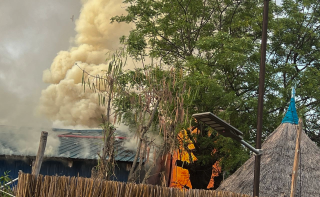
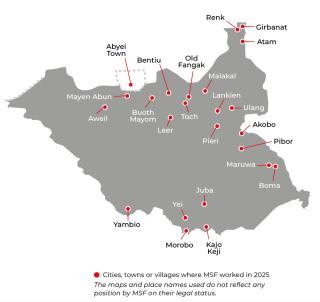
In 2025, there was a sharp escalation in armed conflict, with increasing attacks on healthcare facilities, medical staff, and patients. We recorded nine attacks on our staff and facilities during the year, in locations including Ulang, Old Fangak, Morobo, Yei River, and Lankien. These incidents pushed healthcare even further out of people’s reach. After our hospital in Ulang was looted and destroyed, we were forced to close it and withdraw support to 13 general healthcare facilities in the county. We also closed our hospital in Old Fangak after it was bombed, and relocated activities to Toch. In Central Equatoria state, we suspended activities in Yei River and Morobo counties following the abduction of a staff member. In Lankien, airstrikes near MSF’s hospital forced us to evacuate some staff, leaving a smaller team to continue activities.
Tackling cholera
The cholera outbreak, which began in October 2024 and is the worst in the country’s history, continued to spread across South Sudan throughout 2025, affecting multiple states and putting additional pressure on the overstretched health system. The rapid transmission was fuelled by mass displacement, which was triggered by conflict, limited emergency surge capacity, and chronically under-resourced water, sanitation, and hygiene services. No MSF project across the country was left untouched by cholera.
In January, cases surged in Unity state, particularly in Bentiu and the surrounding areas. Then, in a one-month period, between February and March, a new hotspot emerged, when over 1,000 cholera cases were reported in Akobo, a remote border county in Jonglei state with few healthcare facilities. In response, we established cholera treatment centres (CTC), provided medical supplies, training, and support with treatment at Akobo and Bentiu state hospitals and in Rubkona town. We also assisted with an oral cholera vaccination campaign in Bentiu displacement camp.
In addition, we operated CTCs in Malakal and Ulang in Upper Nile state, and supported the Ministry of Health in the capital, Juba, by establishing a cholera treatment unit, strengthening epidemiological surveillance, running vaccination campaigns, and improving water and sanitation facilities.
Responding to malaria and flooding
Malaria remains the leading cause of illness and death in South Sudan, with outbreaks closely linked to seasonal rains and environmental conditions. The high burden reflects broader gaps in healthcare, including shortages of antimalarial drugs and inconsistent rollout of prevention tools, such as seasonal malaria chemoprevention and insecticide-treated bed nets. MSF conducted chemoprevention ahead of the peak season to protect children under five in the worst-affected counties, including Twic and Aweil. In Yambio state hospital’s paediatric ward in October, during peak malaria season, we donated essential drugs and medical supplies, and trained staff in infection, prevention and control measures and in waste management.
During the year, we also treated people with malaria in Bentiu, Leer, and Old Fangak after severe flooding, which also caused widespread damage and heightened the risk of water-borne diseases, such as cholera and typhoid. In early August, MSF also detected a spike in suspected hepatitis E cases in Aweil, driven by poor water, sanitation, and hygiene infrastructure. Pregnant women, whom the disease most severely affects, along with immunocompromised people, were arriving late to hospital, and some passed away. We responded by treating patients, distributing chlorine tablets, and rehabilitating wells and hand pumps.
Supporting people displaced by the war in Sudan
Since the beginning of the Sudan war in April 2023, more than one million refugees and returnees have crossed from Sudan into South Sudan, placing an enormous strain on local health services, particularly in Upper Nile and Abyei Special Administrative Area. Many people arrived with nothing after weeks of dangerous travel, having endured violence, including sexual and gender-based assaults, and extortion.
As the crisis escalated, we significantly expanded our medical and humanitarian response in Renk. Our teams ran mobile clinics in the informal settlements of Atam, Gosfami, and Girbanat for large influxes of people fleeing violence. We also assisted with water treatment and safe water supply to reduce the risk of water‑borne disease in these areas.
Our teams offered treatment for a range of health issues, including acute and chronic diseases, obstetric complications, violence-related injuries, and mental health conditions. In Renk civil hospital, we worked in the paediatric, maternal, and surgical wards, and the blood bank. We also supported the functioning of the hospital by providing water and electricity, as well as food for patients.
Handing over medical activities to sustain healthcare services
In 2025, we focused on ensuring more sustainable access to healthcare by progressively integrating key services into Ministry of Health facilities. This strategic shift aimed to strengthen local health systems and preserve the ministry’s capacity to respond effectively to emergencies.
In June, after more than a decade of providing care through a hospital in Bentiu displacement camp, we successfully transferred all our core medical services to Bentiu state hospital, a public health facility that we are running in partnership with the Ministry of Health.
In July, we also transferred our long-running activities in Malakal Protection of Civilians site to Malakal teaching hospital, to build a more efficient and accessible health system for people in Malakal and across Upper Nile. In addition, we contributed to the provision of lifesaving surgical care at the hospital by renovating the operating theatre and a 30-bed post-operative ward, and contributing specialised staff to assist with emergency caesarean sections and trauma injuries.
Towards the end of 2025, MSF opened a new project in Upper Nile. Adopting an agile approach to support multiple health facilities along the Sobat River, we started delivering urgently needed medical care to people affected by displacement and conflict.