MSF, Doctors Without Borders, MSF activities in Armenia
In the capital city of Yerevan, we are working with the Ministry of Health at a health centre to provide a ‘one-stop-shop’ service for hepatitis C- testing, diagnosing, and treating patients all in one place.

After more than 100,000 people fled into Armenia following the conflict in Nagorno-Karabakh – a territory internationally recognised as part of Azerbaijan, Doctors Without Borders (MSF) responded by providing psychological consultations, where our teams assessed people’s medical and social needs, and connected them to additional resources and care.

Our aim was to ensure their well-being and offer practical assistance to support their integration into Armenian society. In March 2024, we ended these activities.

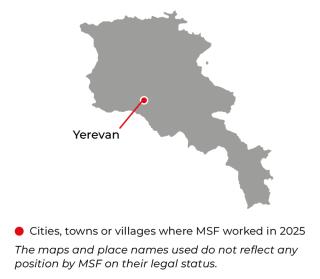
Our activities in Armenia in 2025

Data and information from the International Activity Report 2025.

MSF IN ARMENIA IN 2025 The focus of Doctors Without Borders (MSF) activities in Armenia in 2025 was addressing the high prevalence of hepatitis C through improved testing, treatment, and training, and donations of materials.
MSF activities in Armania

In 2023, Doctors Without Borders (MSF) opened a project at Arshakunyats polyclinic in the capital, Yerevan, which implemented a simplified model of care for people with hepatitis C. As well as providing direct clinical support for patients with the disease, our team introduced new protocols to reduce delays in starting treatment and to simplify follow-up.  

We also conducted training and mentoring activities for local healthcare professionals, enabling them to independently manage hepatitis C patients and integrate the simplified model into routine national health services.

In particular, we worked to improve access to testing and treatment for communities who are underserved and at high risk for the disease, such as people who inject drugs and people who engage in sex work. These communities often face a high disease burden and structural barriers to care. In addition, MSF worked in Armavir prison, expanding testing coverage and treatment among incarcerated people.

Alongside direct medical activities, MSF supported national capacity building through workshops, technical guidance, and donations of equipment and materials. This facilitated the continuation of services within the national healthcare system after we closed the project in December. Our programme in Armenia formed part of MSF’s global work providing medical care to communities with limited access to healthcare, including marginalised people. 

MSF'S MEDICAL ACTIVITIES IN 2025

 
Drug-resistant TB

WHO issues critical new TB treatment recommendations and MSF calls on governments to urgently scale-up all oral treatment

Press Release 28 Dec 2018