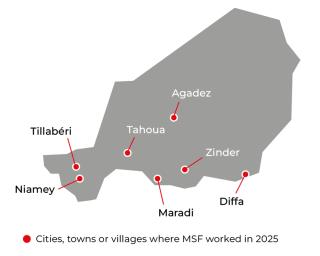
Communities in Niger continue to face health and humanitarian emergencies linked to armed conflict and natural hazards, which are both exacerbated by climate change. In collaboration with the Ministry of Health, MSF worked across our projects to improve access to community-level, general, and specialist healthcare. We also distributed drinking water and essential items, such as hygiene kits, to families, and helped rehabilitate healthcare facilities.
During the peak malaria season, which occurs annually between June and October, we scaled up our activities to support treatment in public hospitals in seven regions. In Tahoua, we responded in isolated areas, and those affected by armed conflict. In addition to working in Madaoua district hospital and three temporary paediatric units in the region, we engaged community volunteers and conducted community awareness as aspects of our malaria and malnutrition response. We also had a particular focus on malaria-related activities, including treatment, community outreach, and patient referral, in Niamey and Zinder regions.
Insecurity, failed crops, and forced displacement continue to have a severe impact on children’s nutrition in Niger. In response to people’s acute needs, MSF runs some of our largest malnutrition projects globally in the country. In Magaria district, Zinder, torrential rainfall causing flooding or the overflow of the Kori de Korama wetland contributes to malnutrition. We worked in the paediatric unit of the district hospital, providing care to children with severe malnutrition. In Maradi region, we integrated the distribution of a fortified flour mixture, called Garin Yara, which supports healthy growth, strengthens the immune system, and helps address nutrition deficiencies, into our malnutrition activities in five health areas of Madarounfa. This included community sessions for caregivers to learn about its use.
Throughout 2025, we also worked to improve people’s access to specialised care, in particular in Diffa and Tillabéri regions. In Diffa, MSF introduced hydroxyurea, an oral chemotherapy drug, to provide a better treatment option to children with sickle cell disease. In Tillabéri, we opened a second operating theatre at Téra hospital, and rehabilitated the operating theatre for caesarean sections in Banibangou. This strengthened surgical capacity, and helped reduce referrals in an area where volatile security conditions can make medical evacuations risky.
MSF teams also worked to bring care to displaced people in Niger. This included expanding our activities in Téra, Tillabéri region. In Agadez region, we continued to assist migrants by providing psychological support, facilitating access to healthcare, and distributing hygiene kits and blankets. In addition, MSF teams carried out search and rescue operations for migrants who had been violently pushed back into the desert from Libya and Algeria, and referred them to facilities where we work in Assamaka for medical and psychological care.