MSF, Doctors Without Borders, MSF activities in Bangladesh

Bangladesh

In 2025, in Cox’s Bazar, thousands of people received healthcare in Doctors Without Borders (MSF)’s eight health facilities.

Around 1 million Rohingya refugees are living in Cox’s Bazar, which has hosted refugees from Myanmar since 1978. As violence continues in Rakhine State, Myanmar, people continue to flee across the border to Bangladesh. They arrive in Cox’s Bazar’s over-cramped living spaces and lack of basic services, finding themselves reliant on humanitarian aid for survival.

We are on site in Cox’s Bazar, running three 24/7 hospitals and supporting in five other health facilities. Our teams provide free-of-charge services like family planning, neonatal intensive care, mental health support, and non-communicable disease management. In 2025, we began a “test and treat” campaign for hepatitis C in the camps, with the aim of treating 30,000 people by the end of 2026.

In 2025, we finished our work in Bangladesh’s capital city, Dhaka, where we were running a clinic for local communities in the Kamrangirchar neighbourhood. As a low-lying coastal country, Bangladesh is exposed to severe flooding and monsoons. Our teams are prepared to support national authorities during flooding emergencies.

Our activities in 2025 in Bangladesh

Data and information from the International Activity Report 2025.
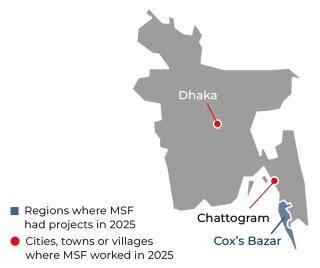
MSF IN BANGLADESH IN 2025 In Cox's Bazar, Bangladesh, home to the world's largest refugee camp complex, Doctors Without Borders (MSF) runs several facilities providing care to Rohingya refugees and host communities.
MSF activities in Bangladesh

In 2025, MSF delivered emergency care, sexual and reproductive health services, mental health support, and treatment for non-communicable diseases and victims of gender-based violence through three hospitals, two healthcare centres, and a specialised clinic. Our teams also treated patients for acute watery diarrhoea, respiratory infections, dengue fever, and measles. The security situation continued to be volatile in and around the camps, due in part to the conflict over the border in Myanmar, which led to further arrivals of refugees. Despite growing needs, the humanitarian response was constrained by a decrease in international funding.

During the year, MSF launched a large-scale hepatitis C ‘test and treat’ campaign to address concerningly high levels of the disease in the camps. We established three specialised treatment centres within our existing facilities, filling a critical gap in care. We also tackled another major public health concern in Cox’s Bazar: water, sanitation, and hygiene conditions. We focused on improving water infrastructure, quality monitoring, outbreak prevention, and hygiene promotion. In 2025, the camps experienced the highest cholera surge since 2017, while scabies prevalence remained high.

MSF’s report, Illusion of choice, reveals that 58% of Rohingya refugees feel unsafe in camps, while 56% struggle to access essential healthcare. Only 37% were aware of ongoing global discussions about their future, leaving them with little agency or clarity regarding their long-term prospects. These figures underscore that, while 84% dread returning to Myanmar without their safety assured, staying in the camps offers them no dignity or control over their lives.

In response to climate-sensitive health threats, MSF launched a dengue response in Chattogram city, comprising vector control, epidemiological surveillance, and community awareness-raising activities. Meanwhile, in March, we handed over our project in Kamrangirchar, in Dhaka, to local authorities. For 15 years, we had run a range of services for factory workers and victims and survivors of sexual violence.

MSF MEDICAL ACTIVITIES IN 2025

 
MSF, Doctors Without Borders, Karsten Noko in Bangladesh
Rohingya Refugee Crisis

“Lives in limbo”: a new challenge as Karsten Noko heads to Bangladesh

Patient and Staff Stories 20 Dec 2022
 
MSF, Doctors Without Borders, Rohingya refugee fleeing into Bangladesh
Rohingya Refugee Crisis

Five years on, three generations of Rohingya talk about their past, present and future

Patient and Staff Stories 18 Aug 2022
 
A young child with scabies at MSF’s Hakimpara clinic in Cox’s Bazar, Bangladesh
Bangladesh

Unprecedented increase of scabies cases in Cox’s Bazar refugee camps

Press Release 16 Mar 2022
 
A picture of MSF assessment team outside the burnt camp in Cox's Bazaar in Bangladesh
Internally Displaced People

Bangladesh: Cox's Bazar Refugee Camp in flames

Press Release 23 Mar 2021
 
MSF Mental Health Centre in Kutapalong Hospital
Mental Health

Bangladesh: Rohingya communities at breaking point

Patient and Staff Stories 25 Jan 2021
 
Mental Health

Living in limbo: Rohingya refugees in Bangladesh three years after the main exodus

Latest News 25 Aug 2020