MSF, Doctors Without Borders, MSF activities in CAR

Central African Republic

Thousands of people have been killed or wounded and millions displaced during years of bloody – but largely neglected – conflict in the Central African Republic.

Since the civil war of 2013, the Central African Republic (CAR) has been marked by cycles of intensive violence. Fighting between the government and non-state armed groups, spurred by an election process, escalated in early 2021.

Doctors Without Borders (MSF) sees the direct consequences of violence on the health of individuals and entire communities. There is a severe lack of access to healthcare; trained health workers are scarce, health services are poorly resourced and often targeted by the conflict; and patients need to travel hundreds of kilometres on dangerous roads to reach medical structures.

In CAR, we focus on treating victims and survivors of sexual violence; provide sexual and reproductive healthcare, including maternal healthcare; and provide treatment to people living with HIV.


Our activities in 2025 in Central African Republic

Data and information from the International Activity Report 2025.

MSF IN CENTRAL AFRICAN REPUBLIC IN 2025 MSF works to address the critical shortage of health services in the Central African Republic (CAR), in particular for women and children in hard-to-reach areas of the country.
MSF, Doctors Without Borders, MSF activities in Central African Republic

The health system in CAR is structurally fragile and underfunded, with one of the lowest doctor-to-person ratios in the world, and only half of its facilities are functional. Epidemics also pose a major challenge, compounded by low vaccination coverage. Access to healthcare in rural, remote areas is further hampered by chronic insecurity, impassable roads, and the high cost of transport to the nearest facility, which is often many kilometres away.

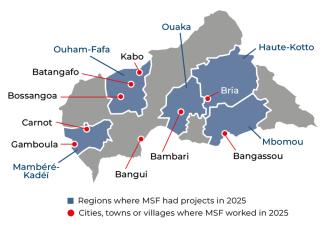
MSF plays a crucial role in delivering essential care in the country, in the capital, Bangui, and in remote regions of Bambari, Bangassou, Batangafo, Bossangoa, Bria, and Carnot.

Improving access to healthcare  

We continue to run a broad range of medical services, supporting health facilities with emergency surgery, intensive care, paediatrics, neonatology, intensive nutrition, treatment for HIV, tuberculosis and chronic diseases, and sexual and reproductive healthcare. In 2025, our teams completed the construction of a 74-bed paediatric ward at Carnot hospital, which we run in collaboration with the Ministry of Public Health.

Maternal, infant, and neonatal death rates in CAR remain among the highest globally, due to inadequate care during pregnancy and childbirth. We are responding by delivering free, high-quality services for mothers and children, such as antenatal consultations, caesarean sections, and incubation for newborns, in all our projects in the capital and in Bangassou, Batangafo, Bossangoa, Carnot, and Bria.  

Malaria is a leading cause of sickness and death in CAR, particularly among children under five years old, and accounts for a large proportion of consultations in health facilities. MSF is working to improve access to diagnosis and treatment by operating ‘malaria points’ in communities, where trained community health workers are able to diagnose and treat the disease early.  

Strengthening vaccination coverage

Low vaccination coverage in CAR triggers frequent disease outbreaks that directly threaten the lives of young children. In 2025, MSF scaled up support for routine vaccination programmes in all the health facilities where we worked, not only increasing the number of vaccinations administered, but also providing a constant supply of medical equipment and training Ministry of Health staff on vaccination. EURECA,* our mobile emergency response team, which conducts epidemiological surveillance across the country, assisted local health authorities with two measles vaccination campaigns in 2025.  

*EURECA stands for ‘Équipe d'Urgence en République centrafricaine’

MSF'S MEDICAL ACTIVITIES IN 2025

 
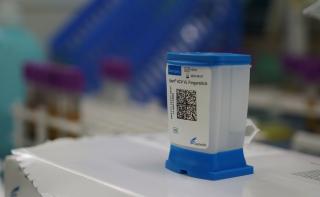
AI tuberculosis screening Central African Republic
Tuberculosis

Far from Bangui how AI is helping detect Tuberculosis in rural Central African Republic

Patient and Staff Stories 22 Jul 2026
 
MSF, Doctors Without Borders, Tuberculosis
Tuberculosis

MSF demands sustained investments and political will to end the neglect of children with tuberculosis

Press Release 23 Mar 2026
 
MSF_ Doctors Without Borders Maternal Mortality crises in Bangladesh, Central African Republic & Nigeria.
Maternal health

Challenges in accessing lifesaving maternal care

Article 21 Jan 2026
 
MSF, Doctors Without Borders, Funding cuts threaten Malaria, TB and HIV care
Access to Healthcare

MSF Warns of Consequences as Funding Cuts Threaten Fight Against AIDS, TB and Malaria

Press Release 22 Sep 2025
 
MSF, Doctors Without Borders, Access to healthcare in Bambari
Central African Republic

Difficult Access to Healthcare for People Around Bambari

Latest News 6 Aug 2024
 
MSF_Mbalazine_Health_Centre_Central_African_Republic
Central African Republic

Central African Republic - A silent health crisis

Press Release 21 Aug 2023