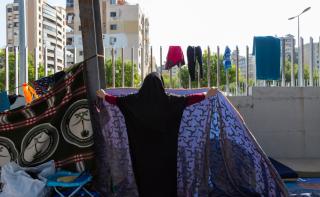
Most people who had been displaced by the Israel-Hezbollah conflict managed to return to their areas of origin, but not necessarily to their homes. Despite the November 2024 ceasefire agreement, Israeli attacks on the country continued in 2025, preventing people’s recovery and taking a further toll on their mental health.
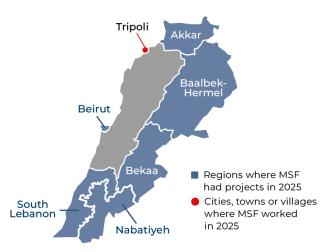
In war-affected areas, civilian infrastructure, including healthcare facilities, was severely damaged or destroyed. We sent mobile clinics to conduct general and mental health consultations for people struggling to access medical services in Nabatiyeh, South, Bekaa, and Baalbek-Hermel governorates. We also rehabilitated three health centres in South governorate to restore care for returnees and displaced people who otherwise would have gone without.
While some Syrian refugees who had been living in Lebanon returned to Syria, there were several new influxes of people during 2025, seeking refuge from violence and fears of persecution back home. To respond to the immediate health needs of refugees arriving over the northern and northeastern borders, we sent mobile clinics in Baalbek-Hermel and Akkar governorates.
In Tripoli, a city in North governorate experiencing severe economic hardship, we maintained our support to a network of healthcare centres, which included donating medicines and providing technical and financial support. Our clinics in Hermel and Arsal in Baalbek-Hermel, and Burj Hammoud and Burj Al-Barajneh, in the suburbs of Beirut, offered comprehensive health services to communities who are otherwise excluded from care, such as Palestinian and Syrian refugees, and migrant workers from sub-Saharan Africa and southeast Asia. Issues such as the high cost of medical care, a lack of local facilities, and uncertain legal status can prevent them from accessing services.
At the end of the year, we closed our Burj Al-Barajneh clinic, where we had been working for more than a decade, as part of our strategy to move towards supporting public health facilities providing similar services to the community.