Since 2021, political instability and armed group violence have reached intolerable levels in Haiti. The Viv Ansanm (‘living together’) alliance, composed of armed groups that had previously fought each other, has gained control of approximately 85 per cent of the capital, Port-au-Prince. In these neighbourhoods, thousands of residents are completely cut off from basic services such as electricity, water, education, transport, and healthcare, and face the constant danger of being caught in deadly crossfire, with no means of escape.
Port-au-Prince has become a battleground, where violent clashes between these armed groups and the police, backed by community self-defence brigades, are a daily occurrence. In 2025, there was a marked escalation in violence, as private military contractors, whose weapons included explosive drones, were deployed in the city. At the same time, the UN Security Council took the decision to progressively send a 5,550-man ‘Gang Suppression Force’ to Haiti, replacing the previous Kenyan-led Multinational Support Mission.
Haiti recorded 8,100 murders during the year. Several major hospitals in Port-au-Prince are still closed due to attacks, looting, or insecurity, making access to healthcare extremely challenging. To date, more than 1.4 million people have been displaced, including nearly 400,000 in 2025 alone. Many live in informal sites, in dire conditions, without adequate water and sanitation facilities.
Where possible, MSF continued to work in this volatile context, despite repeated security threats and incidents that disrupted our operations. On 15 March, we were forced to suspend our activities at Carrefour and Turgeau medical centres due to an upsurge in fighting in their immediate vicinity. As our teams were evacuating Turgeau on board an MSF convoy, our four clearly identified vehicles were shot at, at least 15 times, by a man in police uniform. Our colleagues sustained minor injuries, and we decided to suspend all patient referrals in MSF ambulances. Later in the year, in the absence of sustainable solutions to properly secure our Turgeau medical centre, we had to take the devastating decision to close it permanently, reducing healthcare options even further for people in the city.
Treatment for violence-related injuries
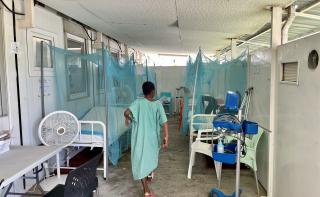
MSF continued to respond to the consequences of armed violence in the capital. During 2025, our medical team in Cité Soleil treated people with violence-related injuries, half of which were gunshot wounds. In our Tabarre trauma and burns hospital, we had to increase our bed capacity from 75 to 90, to accommodate the growing number of wounded patients arriving every day.
On 20 September, many wounded patients arrived at Cité Soleil hospital and Isaïe Jeanty maternity hospital, where we also work, following a drone attack in the Cité Soleil neighbourhood. The majority of the patients were children and women.
Comprehensive care for sexual and gender-based violence (SGBV)
The escalation in conflict in Port-au-Prince has led to a steep increase in the number of SGBV cases, and in the brutality of the attacks. Since 2021, the Pran Men’m clinic we opened a decade ago to provide comprehensive medical and psychological support for victims and survivors of SGBV has seen a threefold rise in the number of patients. An increasing number of them have reported being assaulted several times in their life, and by multiple aggressors, and that it is becoming more and more difficult to obtain proper care on time.
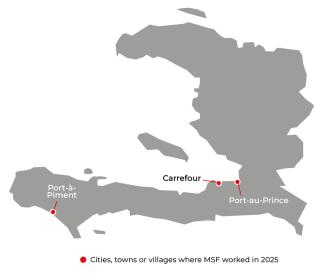
We also continued to run our SGBV-related services at Drouillard hospital, in Carrefour, and at Port-à-Piment maternity hospital. In 2025, we also started offering them at Isaïe Jeanty maternity hospital.
Sexual and reproductive health services
The maternal death rate in Haiti remains alarmingly high. South Department has one of the highest rates, at 344 deaths per 100,000 births. This is due to several factors, such as the lack of functional healthcare facilities, insecurity, and high transport costs, which prevent many women from seeking care.
In response, MSF works in partnership with the Ministry of Public Health and Population, offering emergency obstetric and neonatal services in Port-à-Piment. Our teams assist with births, including those requiring specialist care. To improve maternal healthcare in Port-au-Prince, MSF contributed to the reopening of Isaïe Jeanty maternity hospital, which closed during a wave of violence in 2024. Since March 2025, we have been working with the Ministry of Public Health and Population and other partners to offer assistance with births, outpatient consultations, and contraceptives. We also carried out significant rehabilitation work on the building to increase the bed capacity of the maternity ward.