
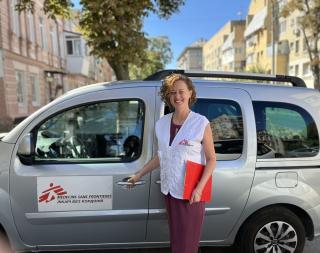
Katsa Juliana Shea joined MSF in January 2022 and has since worked in South Sudan, Bangladesh, and Haiti. In Ukraine, Katsa is based in the coordination office in Kyiv, but works in MSF projects in Dnipropetrovsk, Cherkasy, Donetsk, Mykolaiv, and Kherson regions. Katsa manages three teams of health promoters across these regions.
Health promoters (HPs) are the link between MSF’s medical staff and people in the community. They are truly “on the ground,” meeting with community leaders and local medical staff, engaging meaningfully with beneficiaries, collecting real feedback and life stories, and using data and first-hand accounts to shape MSF’s programs. HPs are two-way conduits, emphasising the need for adaptation, listening, and building trust with the community.

Managing HP teams is an endlessly varied and meaningful job where no two days look alike. In the past few months, the teams have worked on a variety of projects: a new model for a transparent, systematic needs assessment using digital mapping tools; a “Babusya [grandmother] Newsletter” of everyday stories from across Ukraine and beyond to help older women on the front line feel less alone; and identifying other actors and care pathways so those who fall out of medical care can receive care again.
The HPs also teach about topics such as healthy sleep, hypertension, tuberculosis, and antibiotic resistance through games, quizzes, and stories. These tools are referred to as “HP Peppers”, which are creative ways to “spice up” health information.
The world of health promotion is about finding ways to co-create concepts of health with communities that live beyond lecture. Their work is a profound way to reject narratives of destruction and carry forward physical, mental, and social well-being hand-in-hand with their communities.

The absurdity of this war lies in its contradictions: the way life keeps going in parallel with the unbelievable destruction. There is the bravery and the sureness of the Ukrainian will, but also the grief, the fatigue of my friends, and the weight of patients’ stories.
There are times you pass young men every single day, canes in hand and missing limbs. It’s impossible to get your mind around the scale and toll of it all. And yet, somehow, amid this absurdity—the alarms, the shelling, the drones menacing the sky—people still go to parks, children play, and restaurants stay open. The horror and beauty coexist. You can’t help but carry that tension around with you like a small stone in your pocket, all day, every day, trying to understand how it can all be this way, how all of this fits together.
These contradictions don't exist in the abstract; they manifest in real harm. Last summer, more than 300 drones and several dozen long-range missiles were launched at Kyiv in a single night. Rockets and unmanned aerial vehicles (UAVs) struck residential buildings, hospitals, public transport, schools, and kindergartens. According to the UN Human Rights Monitoring Mission in Ukraine, in July 2025 alone, 286 civilians were killed and 1,388 injured—the deadliest month since May 2022.

Even so, the impact is uneven, filtered through different lives. The truth is, I feel it, but not in the same way as my dear friends and colleagues in Ukraine. I’m here, I’m under the same sky, I hear the same blasts, I see the same windows shake. I carry some of the adrenaline and some of the fatigue.Katsa Juliana Shea, MSF health promotion manager in Ukraine
Even so, the impact is uneven, filtered through different lives. The truth is, I feel it, but not in the same way as my dear friends and colleagues in Ukraine. I’m here, I’m under the same sky, I hear the same blasts, I see the same windows shake. I carry some of the adrenaline and some of the fatigue. But it’s not my brother on the front line, not my house reduced to rubble, not my whole village and childhood, upbringing, and family wealth erased. It’s not my history or my culture being fought for.
And so, there’s this constant doubling—where on the one hand I’m walking through it with them, drinking the same four cups of coffee the morning after, caring for the same patients, and on the other hand I know there’s a kind of barrier between their grief and mine, their risk and mine. Which leaves me feeling deeply part of this experience and also, very much outside of it—like I’m inhabiting someone else’s tragedy, but only as a guest, never with full ownership of the pain or the legacy of this war.

One place where this tragedy meets the hand of arithmetic is the count of nights, alarms, and explosions. Since the beginning of the full-scale invasion on February 22, 2022 and the end of August 2025, more than 64,000 air alerts have been recorded in Ukraine, of which 44,685 were threatened by artillery shelling, according to air-alarms.in.ua. Most of the shelling occurs in the early morning, between 1 a.m. and 5 a.m., when people are most vulnerable, tired, sleepy, and disoriented.
The shelling is at once terrifying and oddly banal. Your night is restless because of the scary hum of UAVs followed by loud explosions that jerk you awake, not to mention the way your phone pings every few minutes with some air alert or security information. Yet the next morning, there’s this strange return-to-form, almost a defiance disguised as routine.
As you walk to work the next morning, everyone you pass is tired like you; it’s written on all our faces. You feel a sort of solidarity with everyone, knowing none of you has slept the night before. And when you see your Ukrainian colleagues and ask them how they are, they will often say, “I’m alive,” and it’s not said in an ironic or even melodramatic way; it’s just the blunt, data-like truth of the situation. And you realise that “alive” is both minimal and maximal, the lowest bar and the highest achievement now for everyone who lives in Ukraine.

These experiences reflect a broader reality faced by many. The front line in Ukraine changes rapidly, recently by 10km in one night. As such, there’s been an increased influx of people arriving at evacuation centres set up some distance back from the front line. As you walk past the hundreds of beds side by side in an old school gymnasium, you see so many older couples in their 80s and 90s, sitting quietly under the dim lights, forced to finish out their lives in these extreme circumstances. Recently, I spoke with one man who had walked kilometres to reach the evacuation centre with two dogs and two cats by his side. As we talked, he stood there with the dogs at his feet, sleeping, the cat missing half its face. “These animals saved my life,” he tells us. “There were drones above my head, but they didn’t attack me because they saw I had animals with me.”
One afternoon, as I stepped out of my flat, I glanced upward and noticed my neighbours, this young and ridiculously cute couple, standing at their window. I waved, and the man motioned for me to wait. He disappeared briefly, then returned with the tiniest little newborn baby.
He held the infant up to the window for me to see, beaming with such unguarded pride. I waved back. This image cements itself into my mind: a family, living under drones circling above, so deserving of peace. It’s just one of the countless small miracles that persist. My friend told me that the Ukrainian phrase “бути у надії” used to say someone is pregnant, literally translates to “be in hope.” And for sure, this hope, this investment in the future, is the resilience carried forward.

In Port-au-Prince, women are risking their lives to access sexual and reproductive healthcare
When the world cup came to Chalco, children, football and solidarity across borders
