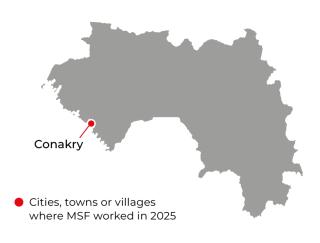
Doctors Without Borders (MSF) has been supporting people living with HIV in Guinea for over 20 years, working to improve treatment and help overcome stigma and barriers to care.
Although Guinea has a relatively low HIV prevalence, accessing high-quality, free, and timely care remains a challenge in the country.
In the capital, Conakry, and the surrounding areas, MSF teams continued to provide medical care for people living with advanced HIV. The Donka unit for care, training, and research, which we manage in the city, offers regular consultations, inpatient treatment, and clinical follow-up for patients in advanced stages of the disease.
In 2025, as well as initiating new patients on antiretroviral (ARV) treatment, we trained healthcare professionals in HIV clinical management, advanced HIV care, prevention of opportunistic infections, and patient support, to strengthen local capacities to enable the gradual handover of activities to the national health authorities. MSF continued to implement simplified models of care designed to bring treatment closer to patients and communities, including ARV drug distribution points.
During the year, we also scaled up our activities for victims and survivors of sexual violence, supporting free, confidential, and accessible medical and psychosocial care which enables rapid treatment at two Ministry of Health facilities. A majority of patients sought care within the first 72 hours, a critical timeframe for effective treatment.
Other activities in 2025 included responding to emergencies. In August, we provided medical and psychosocial care to people affected by a deadly landslide in Manéah, 40 kilometres northeast of the capital. Our teams also donated mass casualty kits, and provided psychological first aid, to three hospitals in Conakry.
In Matoto, one of Conakry’s 13 urban communes, MSF helped Saint Gabriel dispensary, an outpatient facility, respond to a measles outbreak. In addition to treating children, we provided logistical support to improve patient flow and isolation measures, and carried out rehabilitation work to upgrade the facility.