Consecutive failed rainy seasons and drastic cuts in humanitarian funding exacerbated the health and malnutrition crisis across Somalia in 2025. Communities already displaced by conflict and climate shocks faced reduced access to food, water, and medical care. Health and nutrition services either closed or scaled down activities in many districts, just as admissions for severe malnutrition and cases of measles, diphtheria, and acute watery diarrhoea increased. Intensified insecurity and limited humanitarian access further hampered the scale and continuity of our response.
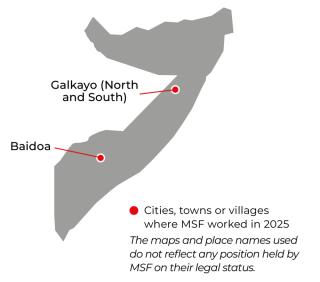
In Baidoa, Southwest State, our teams continued to provide emergency obstetric care, neonatal services, and inpatient treatment for children with severe malnutrition at Bay Regional Hospital. Mobile teams travelled to outlying areas to screen pregnant women and children, administer vaccinations, and refer patients with complications for specialist care.
As drought conditions worsened, we launched emergency water trucking activities and set up water storage facilities in 17 displacement sites. We also installed lighting to improve safety and living conditions.
In August, we opened a 20-bed obstetric fistula unit at the hospital, offering surgery and comprehensive support to women living with fistula, a serious childbirth-related injury leading to incontinence and often severe social stigma.
In Galkayo North, Puntland state, and Galkayo South, Galmudug state, Mudug region, our teams ran emergency, maternity, and paediatric services. We treated children with malnutrition, tuberculosis (TB), and drug-resistant TB, ran the neonatal care unit at the hospital, and sent mobile clinics to displacement sites and remote communities. In these areas, access to healthcare had become increasingly limited as funding cuts reduced services and people had to move in search of pasturable land amid the ongoing drought and conflict. As part of our green initiative at Mudug Regional Hospital in Galkayo North, we installed solar panels, reducing diesel use and emissions, while ensuring reliable power for essential services and strengthening the hospital’s resilience during climate shocks.