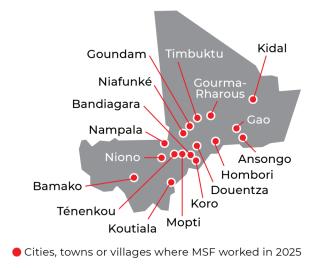
In 2025, thousands of families were displaced by targeted attacks on communities and violent clashes between the Malian army, its partners, and non-state armed groups. MSF teams working around Niafunké, Kidal, Ténenkou, Nampala, and Koro reported that most of these families were displaced to areas with little access to healthcare and other basic services.
We maintained our regular activities throughout the year, supporting health facilities to provide paediatric, maternal, and nutritional care, sexual and reproductive health services, and emergency surgery for victims of violence. We also donated medical supplies and medicines. As the attacks intensified in 2025, we treated many patients with violence-related injuries.
In Koro, we assisted refugees from Burkina Faso by offering basic healthcare, distributing household kits containing items such as soap and cooking equipment, and constructing water points, latrines, and showers.
We also trained healthcare staff and rehabilitated health facilities in Niono, Niafunké, Ténenkou, and Douentza health districts, and continued to run our community-based health services for people living in remote areas who struggle to obtain medical care.
In the capital, Bamako, we worked with the Ministry of Health to improve diagnosis and treatment for women with breast and cervical cancers. This included providing chemotherapy at Point G hospital.
In September, the Groupe de Soutien à l'Islam et aux Musulmans imposed a blockade, preventing the importation of fuel from neighbouring countries. This had numerous consequences for our medical activities: some people were unable to reach health facilities to seek care; patient referrals became slower and more costly; and there were power shortages in some hospitals.
Despite these issues, and other challenges, such as access constraints and physical attacks, our teams made every effort to maintain activities across the country, especially as reduced international funding and the withdrawal of several humanitarian organisations further diminished the provision of services and assistance.