
Mozambique
“There is hope and a life ahead”
Press Release
14 Dec 2021

As the conflict in Mozambique entered its eighth year, attacks by Islamic State Mozambique intensified in Cabo Delgado and Nampula provinces, triggering widespread fear and three waves of displacement between July and December, during which around 300,000 people fled their homes. Many were displaced multiple times, sometimes returning to camps they had left years earlier. The high levels of insecurity put an additional strain on the already fragile health system, further reducing access to essential services for displaced people and host communities.
MSF conducted a range of activities in 2025 to fill gaps in healthcare. Across all our projects and emergency responses, we ensured the integration of prevention, diagnosis and treatment for HIV, tuberculosis (TB) and malaria, leading causes of death in Mozambique.
Conflict, displacement and climate-related disasters continued to shape the humanitarian landscape in northern Mozambique throughout 2025, placing immense pressure on already fragile health systems and vulnerable communities.
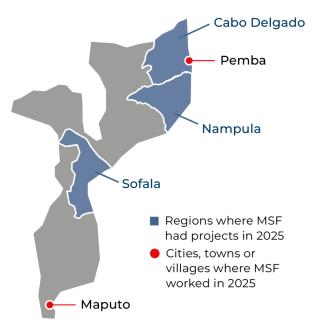
Cabo Delgado remains the epicentre of the crisis. In Macomia, we resumed activities we had suspended following an attack in 2024, relaunching mobile clinics and constructing what is now the only operating theatre in the district at a Ministry of Health facility, bringing care that would otherwise be two hours away. In Muidumbe and Nangade, we worked in local health centres and trained community health workers, while in Mueda, we provided medical staff, supplies and technical assistance to deliver emergency maternal, paediatric, neonatal and mental health care, as well as referrals, at the rural hospital. In Palma, we temporarily suspended our mobile clinics and outreach activities during peaks of insecurity. Likewise, in Mocímboa da Praia, one of the conflict’s hotspots, we ceased operations in September due to attacks and threats. We gradually resumed work in December, focusing on critical hospital services, mental health, and outreach.
Mental health care remained a core component of our work. As well as conducting individual and group consultations, we trained community members to increase awareness and acceptance, and health staff to improve referral systems.
Early in 2025, we wound up our emergency response to Cyclone Chido, which had caused major damage to health facilities and water systems, and spikes in malaria and diarrhoeal diseases. Our teams supported recovery by restoring essential services and offering psychosocial support.
In Beira, Sofala province, we handed over the sexual and reproductive health project that we had been running for over a decade to the Ministry of Health, marking the end of our major contributions to HIV prevention and treatment in the area.
In June, we also concluded regular activities in Nampula, where we had worked to improve care for malaria and neglected tropical diseases, including surgery for hydrocele, a complication of a tropical parasitic disease called filariasis, which causes an abnormal accumulation of fluid in the testicles. We remain ready to provide support during new emergencies.
Between July and December, in Chiúre, Mueda, Mocímboa da Praia and Eráti districts, MSF provided medical consultations, maternity care, screening for malnutrition, mental health support, referrals, and water, sanitation and hygiene services to displaced and host communities. In addition, we supported the Ministry of Health to tackle several cholera outbreaks across Cabo Delgado and Nampula.


