MSF, Doctors Without Borders, MSF activities in Zimbabwe

Zimbabwe

In Zimbabwe, the economic situation continues to decline, with very little funds available for public expenditure and social services. As a result, the health sector faces numerous challenges, including shortages of medical supplies and essential medicine

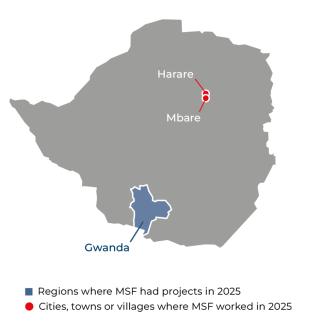
Throughout 2025, Doctors Without Borders (MSF) increased access to healthcare for people facing structural barriers to essential services, including adolescents and young people in Mbare and Epworth and artisanal miners in Gwanda District. Across both projects, our focus remained consistent and intentional: bringing integrated, quality care closer to communities.

Our activities in Zimbabwe in 2025

MSF has a long history of implementing programmes in Zimbabwe, including support to the country’s response to HIV, tuberculosis, sexual reproductive health,and public health emergencies. Over the years, we have supported outbreak responses, strengthened diagnostic capacity, and introduced innovative models of care designed to reach people facing structural barriers to accessing services.

Zimbabwe Annaual Report 2025 pdf — 28.96 MB

Download View online

MSF IN ZIMBABWE IN 2025 In 2025, our teams continued to adapt our medical and operational approaches to reach underserved communities, reinforcing our commitment to equitable access to healthcare in Zimbabwe.
MSF, Doctors Without Borders, MSF Activities in Zimbabwe

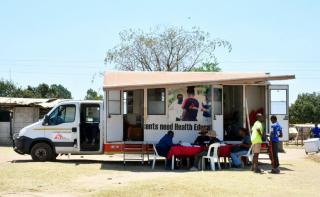
In Gwanda, MSF provides medical care to artisanal miners, their families and host communities through mobile clinics. People in this hard-to-reach area are exposed to health risks linked to unsafe working conditions, a lack of local health facilities and other barriers to care, such as affordability. In 2025, MSF ran a range of medical services at 36 mining locations, including general healthcare, treatment for HIV, tuberculosis (TB), silicosis and mental health conditions, and health promotion.  

To facilitate earlier detection and diagnosis of TB and silicosis (a lung disease that typically affects people working in construction, mining, and stone cutting) in these remote communities, we introduced a portable x-ray and computer-aided detection system. We also adopted a peer-led model for mental health care, recruiting peer educators who are integrated in the community and can refer people for mental health services with MSF.  

In Mbare and Epworth, densely populated settlements in the capital, Harare, MSF teams continue to offer youth-friendly, one-stop sexual and reproductive health services, focused on addressing the multiple and evolving health needs of adolescents and young people. We offer testing and treatment for HIV and sexually transmitted infections, as well as HIV pre-exposure prophylaxis (PrEP), counselling and mental health support. Through our peer-led, community participation model, we also worked to reduce barriers to access, promote continuity of care and strengthen adolescents’ agency in managing their health.  


IN 205

 
HIV/Aids

Providing new community-led models of HIV care in Mwenezi, Zimbabwe

Latest News 30 Nov 2018
 
HIV/Aids

“The greatest impact we made in Mwenezi was reaching the people and providing the services that they require.”

30 Nov 2018
 
Cholera

Preventing cholera outbreaks with longer term solutions in Zimbabwe

Latest News 29 Oct 2018
 
Cholera

Zimbabwe: Responding to cholera in Harare

Latest News 24 Oct 2018
 
Zimbabwe

MSF Zimbabwe Newsletter: June 2018

Newsletter 2 Jul 2018
 
HIV/Aids

Zimbabwe: Providing adolescent sexual and reproductive services in Mbare

Latest News 12 Mar 2018